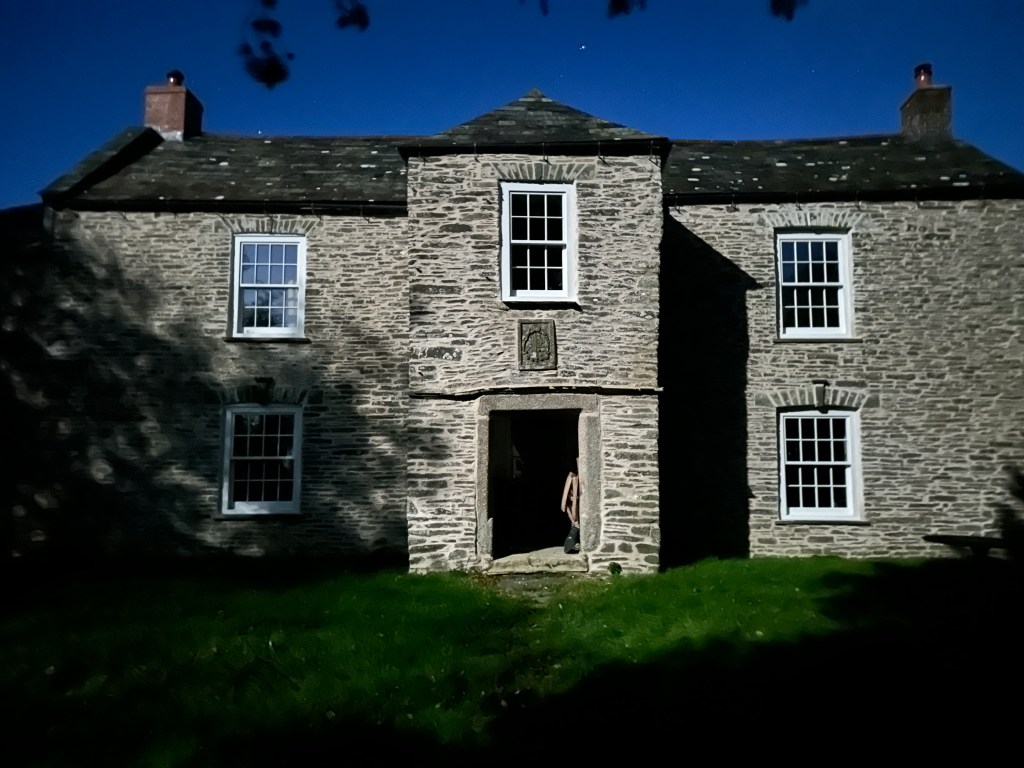
It is almost one month exactly since Fiddian, my husband of 8 years, partner of 14, died in front of me in our living room in Bossiney Court at the far-too-young age of 61. The moon was full the night before, and so bright that it had woken me at 5.30am and prompted me, most unusually, to go outside and photograph the effect: our house bathed in moonlight despite it being night, still. I showed him the photo later and we marvelled at the beauty of it – one of the last things we would do together.
Today I am in Venice, here to support my stepson’s partner as she performs a piece in the Biennale, and the moon is full once again, reminding me that the earth keeps turning and that Fiddian, impossibly, is no longer here.
I want to write about Fiddian’s death for several reasons. Writing about things has always helped me to process and to understand things, and I know that, for some people, reading about things (even very painful things) can also help to process and make sense of them. I also find that I do not wish to be quiet or private about what happened to me and to our family. It was – is – shocking and significant. It is worthy of attention.
At the date of writing this, I do not know the cause of Fiddian’s death. We are still waiting for the results of his post mortem, delayed because the coroner is waiting for test results on a tissue sample taken from his spleen. I could speculate at length on the cause, and have done so with his family and GP, but I simply do not know for sure.
What I do know was that something had been wrong for some time, although no one, including Fiddian, his GP or myself thought it was life threatening. He had begun to experience chest tightness in the summer of 2023 – a nagging annoyance until the winter, when it began to lead to pains in the shoulders and back, shortness of breath and nausea – classic symptoms of a heart attack. These symptoms came and went over several months, until they crystallised in early spring, leading to a trip to the GP, several tests and strict instructions to Fiddian to stop gig rowing (a very strenuous sport practised locally in Cornwall) and to call an ambulance if the symptoms reoccured. This they duly did in early February, when I called an ambulance for him at around 6am and we waited several hours for them to arrive. The ambulance crew promptly carted him off to our local hospital (over an hour’s drive away), but the symptoms subsided and (apart from the persistent chest tightness) never happened again.
A battery of tests followed, including several ultrasounds, a PET CT scan, a 24-hour blood pressure test and several other tests that I have forgotten. Apart from a small cyst on his lung, which was most likely benign, all the tests showed was a perfectly healthy man. Fiddian went back to leading a full and active life until two weeks before his death. He kayaked on the open sea, danced at festivals, worked full-time hours project managing our house renovation, holidayed and hiked in Sardinia, walked our dogs up and down the coastline most days, laughed, joked and had a great time, until the start of October.
I came back from a visit to my parents in Scotland on October 9th to find Fiddian with what seemed to be a stomach bug. He was tired and nauseated, with periodic bouts of feverishness. James, our carpenter, had been suffering from a bad stomach bug that same week, as had multiple other people we knew. We assumed it was the same bug and waited for it to go away.
Several days later, after he had been ill for over a week, Fiddian, who prior to this past year had almost never been ill at all, seemed worried and actually Googled his symptoms. “If it was a stomach bug I think it should have gone by now,” he said. “Maybe I’ll call the GP on Monday morning.” After that, Fidd began to feel pain below his ribcage, as well as more persistent nausea and fatigue. He woke up in the night drenched in sweat and struggled to get any sleep. During the day on Sunday he gradually seemed to get better and was able to potter about doing odd tasks. I cancelled some work travel I had organised and began to be properly worried.
On Monday we went to the GP together – something we had never done before. His GP, who is excellent, carefully prodded and tested his stomach and ribcage area to try and locate the source of the pain. He thought he could detect an enlarged liver, but there was nothing else striking. He took some bloods and suggested that it could be gastritis or pancreatitis. He asked a lot of questions, including what we had eaten on our recent trip to Sardinia. We went home reassurred that investigations were in hand and that there were some likely explanations. Later that day the GP called to say that the blood tests showed a drop in Fiddian’s white blood cell count and that we should come back in the morning.
When we arrived at the doctor’s on Tuesday morning the first thing his GP said was “I hope you didn’t do any Googling last night” – as it turned out, neither of us had, but this immediately put me on high alert and I could see the doctor was more worried than before. He took more bloods, did more prodding, ordered an ultrasound, but still found nothing conclusive. We went home and I (privately) did some Googling and read the word “leukemia”, but the list of symptoms didn’t seem to fit at all. The GP had mentioned hepatitis as another possibility, and I told myself that that seemed more likely. Although we were all worried at this point, no one was panicking.
Over the next few days, not much changed. Fidd would sleep badly, wake up feeling tired, then gradually get better during the day. He was still able to move around and do jobs around the house. We walked the dogs on one of those days (our last dog walk). We watched a film with Brad Pitt and George Clooney that he didn’t enjoy, and Pulp Fiction (which he did). I’m glad that the last film he watched was such a good one.
On the day he died I drove him to the doctor’s in the morning for another blood test. Nothing had changed – his white blood cell count had not gotten significantly worse, nor better. No other markers had changed significantly. We were advised to check his bloods again on Monday, and to call 111 if anything worsened over the weekend.
I drove into Wadebridge for a hair appointment and when I got home in the late afternoon I couldn’t find Fiddian anywhere. Eventually, I found him sitting outside in the Walled Garden, in a deckchair reading a sci-fi novel, wrapped up against the cold. He looked a little vulnerable, sitting there, but I was glad he was outside getting some sun.
I took the dogs for a walk, then when I came back, we went into the renovated side of the house and climbed up the ladder so he could measure the size of different doorways and order timber to make the doors. We talked about door design and then went back to the other side of the house to make dinner. I cooked salmon and broccoli and Fidd made a tahini sauce.
At about 7.30pm the food was ready but suddenly he wasn’t hungry. At this point he was sitting on the sofa by the fire and feeling very nauseated. I quickly went into the kitchen and scoffed down my portion of food before heading back to be with him. He began feeling stronger pains up under his ribcage, forcing him to lie down on the couch.
At about 9pm the pains got bad enough that he suggested I call 111. I did so, and was appalled at the number and length of the recorded messages one has to get through before one can speak to a human. Looking back at my phone records I can see I was waiting for 2 minutes before Fidd said “I think you should just call an ambulance”. I hung up and called 999 and went through the already familiar process and heard the already familiar sentence “The ambulance service is under significant pressure”. They assured me they were sending one, but couldn’t give an ETA. Based on what had happened previously, I knew it could be more than 2 hours.
The next period is something of a blur, but I know I waited 40 minutes before calling 999 again to say the pains had gotten worse. In the intervening time I had taken his blood pressure and found it very low. He was bent over double for long periods and unable to get comfortable, moving between the sofa and the floor. At one point he thought he was blacking out. He needed to go to the toilet but couldn’t get up the stairs so I improvised with a bowl and flannels. He was sweating and delerious but also conscious and talking to me. I mopped his forehead with a cool flannel and he said “that’s lovely”. That was the last significant thing he said before the ambulance crew arrived.
Suddenly two young women in green uniforms were in our living room. They looked shocked and didn’t seem to know what to say. I kept thinking “why aren’t they taking charge?” “why don’t they know what to do?” They spent a lot of time trying to take his blood pressure but they couldn’t get the machine to do a reading because he couldn’t stay still. His breathing was still strong at this point and he could respond briefly to questions. At a certain point they decided we would need to take him into hospital. I had to go out and move our car out of the way so they could back the ambulance up to the door. I called my neighbour to please come and take the dogs away (they had been lying in their beds or nearby, watching the whole thing up until this point).
When I came back into the living room he was still on the sofa but I could see he was losing consciousness. I remember gently slapping his face and telling him he was doing well and to stay with us. He was no longer able to talk and I saw his eyes closing. In my mind that’s when I lost him.
I don’t really remember what happened next in clear detail. The three of us somehow moved him to the floor and I remember holding a bag of saline above his body while they radioed for further assistance. One of them had an oxygen mask over his face and then they put something down his throat. When my neighbour arrived they kicked me out of the room. “I think he’s dying,” I said to her and she lead me to another room, horrified.
At some point a first responder turned up and the three of them spent the next 30-40 minutes manically trying to keep him alive. They used a defibrillator, injected him with adrenaline and manually kept his heart going between the three of them. Throughout most of it I was sat at the table in the next room with my neighbour, listening to the awful noises. At more than one point I just wished for them to stop. When I looked in what I saw was chaos, and three desperate people engaged in a hopeless task.
Finally, three very serious looking people in red air ambulance uniforms appeared out of nowhere and went in to the living room. A few minutes later one of them came out and approached me to tell me what I already knew. They asked me if I wanted to hold his hand when they stopped administering CPR. I went in, held his hand and they stopped and stood silently while I howled. The time was 12 minutes past 11. How long did we stand there like that? I don’t know. When I looked up I saw expressions I had never seen before directed at me. The one who had told me put her arms around me while the others began to clear up and move away.
 bookbusbird
I have been wondering about your renovations and was excited to see a post from you. The title could have referred to anything but what it does. I cannot tell you how shocked I am and – too – how grateful I am that you are sharing this awful life experience, for I am on the cusp of that. There are few words that seem appropriate in a situation like this. My condolences are there to give … my wish for inner strength for you is sincere … I hope you will be surrounded by the love and support of family and friends.
LikeLike