I wanted to write something from a widow’s perspective one year on. In the first weeks and months I searched online a lot to try and understand how long it would take me to feel better. The pain is so excruciating that you are desperate to find out from others how long they had to endure it. Surprisingly, the most useful source was ChatGPT, but it was simply aggregating data into averages and platitudes. There is very little concrete information about how it feels to lose your spouse and how long it takes to recover so I thought I would write up my “case study” in case it helps anyone else.
It is obvious, of course, that everyone experiences grief differently and that my circumstances are unique to me. In particular, I think age and the length of the relationship are a significant variable. I was 46 when Fiddian died, and we had been together for 14 years. That is still relatively young and relatively short. I would expect that someone aged 65 who loses their spouse of, say, 40 years, would be hit harder, particularly if that person had had few other romantic relationships. I was in my thirties when I got together with Fidd, and I had had plenty of experience of dating and several other happy relationships before him. This gave me a foundation of confidence that my romantic life was most probably not over, and that helped me to avoid despair.
The other thing that really, really helped me is that Fiddian and I were in a very good and settled place in our relationship when he died. You might think that that would make things worse, but in fact it was very soothing. Our relationship had been mostly very happy, but we had had a rocky patch a year or so before we moved to Cornwall and had gone for relationship counselling. The counselling had been tremendously successful and had helped us to confront some big issues that we had been avoiding and to resolve them together, giving us an even stronger foundation and love for each other. Of course his death was a huge shock and wound to me and I felt (and still feel) cheated of his presence. But I can truthfully say that on the day he died everything stood happily between us and there were no unresolved tensions or issues. He knew I loved him deeply and vice versa. There is nothing that I wish I had said to him and no question that I wish I had asked. If I have one piece of advice to give to anyone reading this it is to think carefully about how you would feel if your partner died today. If there are unsaid and undone things that you would regret, address those now, before it is too late.
Following on from that, the other thing that has made a huge difference this past year is that I started talking to a counsellor within a week of Fiddian dying and continue to talk to her today. In fact, she is the counsellor who helped us during our rocky patch, and so she knew Fiddian and understood our relationship. Obviously not everyone will be so lucky to have someone like that to reach out to so quickly. However, I would advise anyone in my situation to find an experienced counsellor as quickly as possible (ask your friends to recommend one as searching online can be too overwhelming). Talking to friends and family will obviously help, but I don’t think it is enough in the case of a traumatic death. I have felt very very mentally unwell at numerous points during the past year, and having someone skilled to lean on in those moments has been a godsend. Family and friends have a vested interest in you doing well and in appearing to get better, and that puts an unconscious pressure on you to match that narrative. A paid counsellor has no such vested interest and so you can freely use them as a pressure valve, sounding board or a padded cell to let out what is inside. There is absolutely no way I would be as healthy as I am today without my counsellor.
So how has my timeline worked for the past twelve months? I’ll start at the end. I feel much better. Not “normal”, not “happy” but mostly ok. I still feel pain and I cry a little most days, but I am not in agony or scared about my wellbeing. I enjoy life, although that enjoyment is hampered by guilt and sadness. (The guilt is hard to explain, but common. When I feel happy, I remember that he isn’t around to enjoy life, and I feel guilty that I am. I assume this will pass one day, but it is constant right now.) I am fairly confident that I am gradually “getting better” and that I will not return to the lows I experienced in the past year. My counsellor says I am doing incredibly well and we have reduced our sessions to once per month instead of once per fortnight.
I have not experienced “stages” of grief that I could reliably demarcate and my journey has not been linear. In fact, I hit absolute rock bottom nine months after Fiddian died, when I temporarily thought I was losing my mind. It turned out that this was the darkness before the dawn, and from month 10 onwards I began to feel a lot better.
The weeks and months immediately after the death sort of take care of themselves as they are so busy and so many other people are around helping that you are carried forward by the momentum and constantly distracted. In my experience it was the time after that when things became really challenging. I dealt with this in quite a unique way, which I’m not sure I would recommend, but which perhaps helped me to process my grief quite effectively.
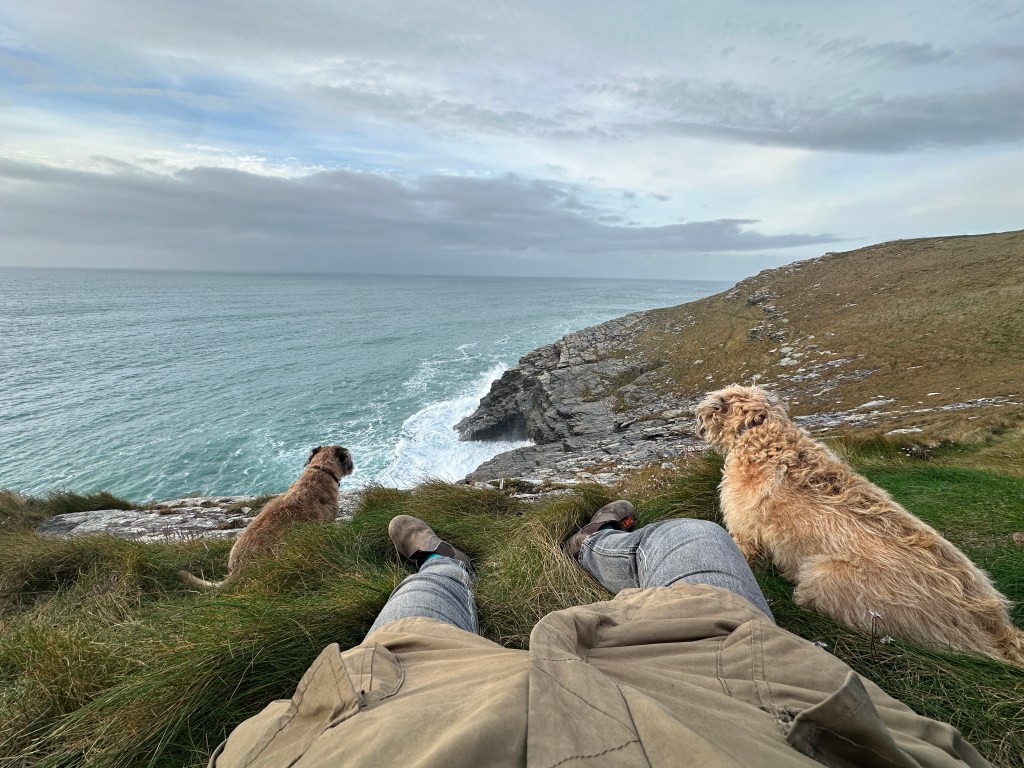
Fiddian and I had moved together to Cornwall just over two years before he died, and so, although we had friends in our community, we were very much new to the area and very far away from our respective families. I was also working remotely and so when he died I did not have a network of colleagues, close friends or family members to call on for physical support and company (phone, email and social media are great, but no substitute for real presence). Added to that it was the depths of winter and I was living in our partly renovated house, which had only one room with a heat source. This room also happened to be the room where he had died. In effect I therefore had very little choice but to spend most of my time, from November through to April, sitting alone in the space where he passed away. When I think about it now, it seems utterly extraordinary that I put myself through that. I relived the moments surrounding his death countless times every day for months with just the dogs and the odd visitor for company. I took the occasional trip to London for work and my sanity, and went out to visit kind friends now and then, but otherwise I was either in that room or somewhere nearby all the time. It was an enormous feat of endurance but it meant that I was feeling grief, misery, sadness, anger, pain, fear and everything else without distraction. One year on I feel strongly that I have suffered enough. I put myself through that intensity, and now I don’t need to again. The emotions I feel now are more muted and less painful because I let them be so strong for those months. In April I watched the room where he died be obliterated. The walls, ceiling, floor and fittings were ripped out. Nothing survived. Now that small, dark, cold room is a huge, light, warm, open space that I can enter without remembering.
What has been the hardest part of the past year? The loneliness, without a doubt. Somewhere I read that “grief is love with nowhere to go” and that resonated more than anything else. I am a caring, tactile person, and I loved Fiddian very deeply. Our relationship was close and highly expressive. Losing him was like being tortured, for a time. I also started to feel like I didn’t exist. It didn’t matter how many other people I spoke to or saw; not having him to talk to about the inconsequential details of my day was a loss so great I felt obliterated by it.
One can get used to almost anything, it turns out, and I gradually adapted to the lack of physical contact and to being “unknown”. There were even moments when my anonymity and invisbility in the world felt like freedom. One day in early May I was on a much delayed flight from Lisbon to Bristol and I realised that there was no one who knew where I was – no one waiting impatiently by the phone or at the airport, and therefore nothing to be stressed about. I landed in Bristol at 1am and drove slowly home along a moonlit M5, feeling almost blissful. In late June I was driving home to Cornwall from London and decided, on the spur of the moment, to go clubbing in Bristol. I had an amazing night dancing on my own and laughing with strangers next to a giant sound system. Someone broke into my car overnight and stole my bag of pound coins and selection of sweets, which I still find funny. Things that once would have bothered me just didn’t matter anymore.
But although I got used to being alone I was still deeply lonely. I had had several aborted attempts at dating near the start of the year, and although I met one very lovely person I realised that I wasn’t ready or capable of being with anyone else so soon. Over the summer I met and became friends with someone local. We began walking our dogs together and talking most days. I noticed that after I had spent time with him I felt calm and peaceful. He had experienced a loss similar to mine three years earlier, and so my grief was familiar to him and nothing off-putting. We started to see each other more seriously towards the end of summer and this relationship has really helped me to feel more human and more whole again. I feel very fortunate to have found someone who can handle my situation and my rather limited capabilities. I don’t think this would be possible if he wasn’t also well versed in grief.
I am not sure if I will ever want to marry or even live with someone again, but I love having someone to talk to, to walk with and to discuss the world with. Experiencing long-term, blissful companionship and then having it torn from you in a moment is the most terrible experience. It is a rare human being who can truly thrive without physical and emotional closeness. Being with someone new, even in my rather limited capacity, has helped me to heal and to move on. I do not know what the next year will bring and I have learned that hope is often misplaced so I no longer indulge much in it. All I know is that today I feel alright and that is enough for now.
What else would I say to someone unfortunate enough to find themselves in my situation? You are going to need to learn to be extremely kind and indulgent with yourself, in a way that may seem very unnatural when you have been used to compromising and considering someone else in most matters. People will have expectations of you, and you must try to put these out of your mind. How you cope now is entirely up to you and not down to some script. If you need to drink a bottle of wine each night, or sleep around, or move to another country or cut off contact with your friends, that is what you need to do. If you need to move out of your house, quit your job, cut off your hair, or spend hours every night listening to old voicemails, so be it. You must protect yourself now, because no one else, despite their best intentions, will do that for you. And remember, unless they have been through it themselves, other people are probably not going to be able to understand everything you need to do, and that is ok. You don’t have to turn into a monster, but it is ok to let people down if it means doing the right thing for you.
 bookbusbird
The last sentence of your 3rd paragraph reminds me of the multiple similar advice from the Spirit World, obtained by renowned psychic medium James Van Praagh for his clients… “Don’t leave behind unfinished business” … He even wrote a book based upon those spiritual messages and called titled it- “Unfinished Business”. It’s sad for the souls if they could have, should have or would have done something BUT didn’t, while they were still living in the human vessel… When such souls cross over to the Spirit World, they regret not resolving their relationship issues…
LikeLiked by 1 person
Oddly enough, I was thinking about you only a few hours ago and wondering how you are managing. This may well be because my daughter-in-law’s father is on his deathbed and so she and her brother have flown in from abroad to support their mother. I cannot help feeling pleased that you have found a kindred soul who provides you with comfort and companionship. As always, I wish you future happiness.
LikeLike
Hi Kirsten – I am thinking of you especially now I’m in St Ives at the School of Painting on the artists’ retreat with Ilker Cinarel and Liz Hough. I’m so pleased to read your Nov update, so direct and eloquent as always, and I hope we might end up on another art course together one day. The crab sarnie (w rosemary fries?) is on me. Just seen a money pit for sale in Launceston for £99,000 – uh oh…
Best wishes – Vivienne
LikeLike