I’ve been thinking about change and how we adapt to it, and what we take from the environment immediately around us. Since January 6th I’ve been reading Hanif Kureishi’s magnificent daily blogs about his life since he became paralysed after a fall in Rome. His world, which was previously planet-sized with possibility, has shrunk to the inside of a hospital facility; and his ability to operate his body (which is after all, a person’s most immediate environment) has also shrunk, making him completely dependent on others for survival. He reflects on his own quick adaptation to extraordinary new circumstances, dictating his thoughts to his wife and son to share with us.
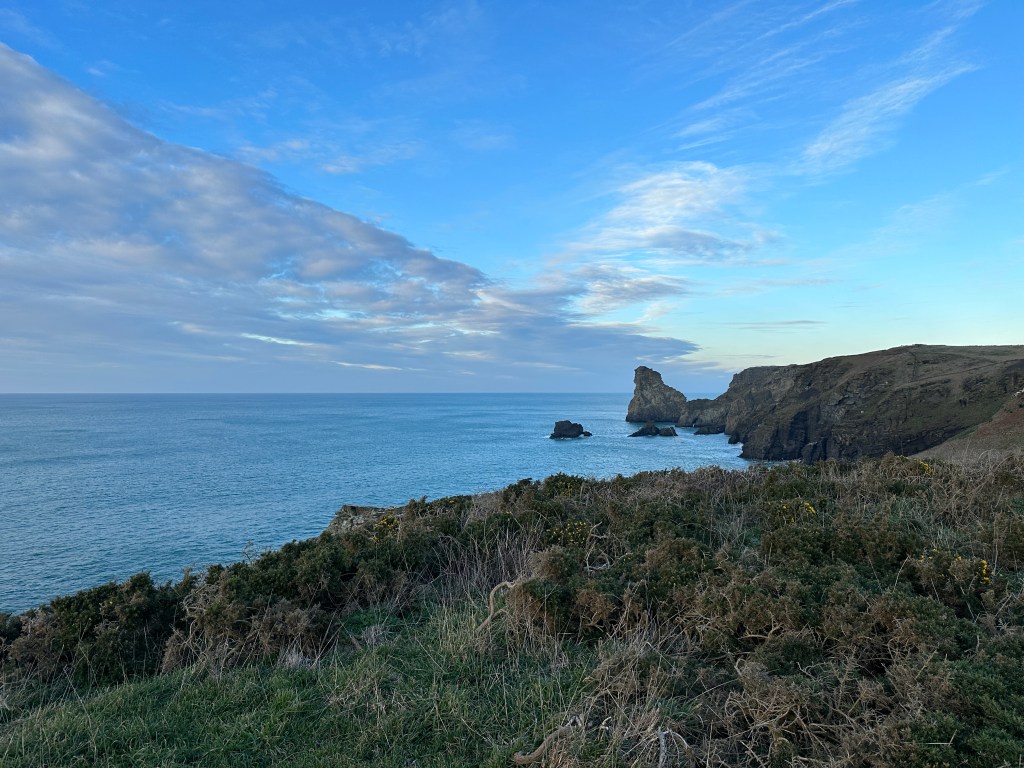
I muse on this as I tramp across the North Cornish sea cliffs, often under cloud; occasionally in blazing sunlight, and I think about Roger, who lived in our house before we did, in the side we seldom go into: the side that is full of holes, leaks, draughts, bats; and which is quickly succumbing to the elements. Roger’s side of the house is adapting to its immediate environment by collapsing under its onslaught. Part of what we plan to do involves reversing this adaptation: a plan for which I sometimes feel oddly guilty.
I know a little about Roger from this website, which describes his work as the potter who threw most of the ceramic work in the former Tintagel Pottery, which is also now crumbling away on another part of our property, and which my husband is currently using as his workshop.
What else I know about Roger comes from the reminiscenses of our neighbours, most of whom describe him as a reclusive man, somewhat morose; perhaps a little intimidating. He resisted the pottery’s inevitable closure, working well into his old age and probably encouraging Enid (who lived in our side of the house and decorated what Roger threw) to continue working alongside him until a fall and a broken hip finally put paid to that. (In fact, Enid didn’t work alongside him. She painted the bowls and cups and butter dishes in the glorious sunlight which streams through the top floor of the pottery, whereas Roger spent his working life downstairs in the dark, cold and damp confines of the throwing room).
As Roger got older, his world inside our house shrunk to “the den”, where he would sit and smoke. Judging by the state of the rest of his side of the house he seldom went into it, but it is hard to know. I don’t wish to write a history of someone who seemd to want to not be known, but I cannot help writing a story in my head. One day we hope to turn the den into our kitchen, where we will cook and play loud music and dance and maybe even kiss. For now, we have left the traces of Roger intact. His cigarette papers are still on the floor, near the bucket that used to catch the drips. I can almost see him sitting there.
One of our neighbours told me that Roger would emerge once a day for his walk along the cliffs. When encountering others he would not stop long to chat, but would invariably comment on the visibility or invisibility of the island of Lundy. Lundy, previously just a name in the Shipping Forecast to me, is a small island sitting 19 kilometres to the north of the coast, in the Bristol Channel. On certain days its shipwreck-inducing bulk is clearly visible on the horizon; on others it is completely obscured. Every day I walk down to the cliffs and every day I find myself looking for it. Sometimes I will comment to myself or to the dogs: “There it is!” or “Hard to see today.” The other day it occurred to me that I do this because Roger did it. Somehow, this man I never met, from a place I never intended to move to, has reached out across time and changed me. I thought we had moved here to change this place; now I realise it is changing us.


so excited when I found your blog! We live (sometimes) in Boscastle and saw Bossiney Court for sale – we are v impressed with what you have/are doing. Well done!
Sara Morgan
LikeLike